





Executive Summary
The market for GP-Led Secondaries, and continuation vehicles in particular, continues to be influenced by a structural mismatch between the volume of assets seeking solutions and the pool of capital available to provide them. Nowhere is this gap more pronounced than in the middle market. We believe there is a significant unmet need for GP-Led Secondaries solutions within middle market portfolios. At the same time, many of the historic middle market-focused Secondaries buyers have migrated up-market, a dynamic that H.I.G. Capital (“H.I.G.” or the “Firm”) has observed across asset classes over its 33-year history while remaining disciplined in its focus on the middle market.
This paper seeks to address three points. First, the supply and demand imbalance in middle market GP-Led Secondaries is the most pronounced capital formation mismatch in private markets today. Second, the large wave of potential transaction activity that is coming; 2020 to 2022 vintage-year transactions are entering their phase of ownership that is prime for a continuation vehicle solution. Third, and most importantly, a broadening opportunity set reinforces asset selection and solution flexibility as two of the most critical variables. Through its Secondaries platform and an exclusive middle market focus, H.I.G. is well positioned to partner with sponsors to identify and invest in strong-performing assets across a broad range of situations.
1) The Supply and Demand Imbalance Is Most Pronounced in Middle Market GP-Led Secondaries
Market datapoints have consistently reported that readily available capital in Secondaries portfolios covers approximately one year of transaction volume, which ranks as one of the largest supply and demand imbalances across private markets. The need for capital formation is a precursor to driving further transaction activity.1
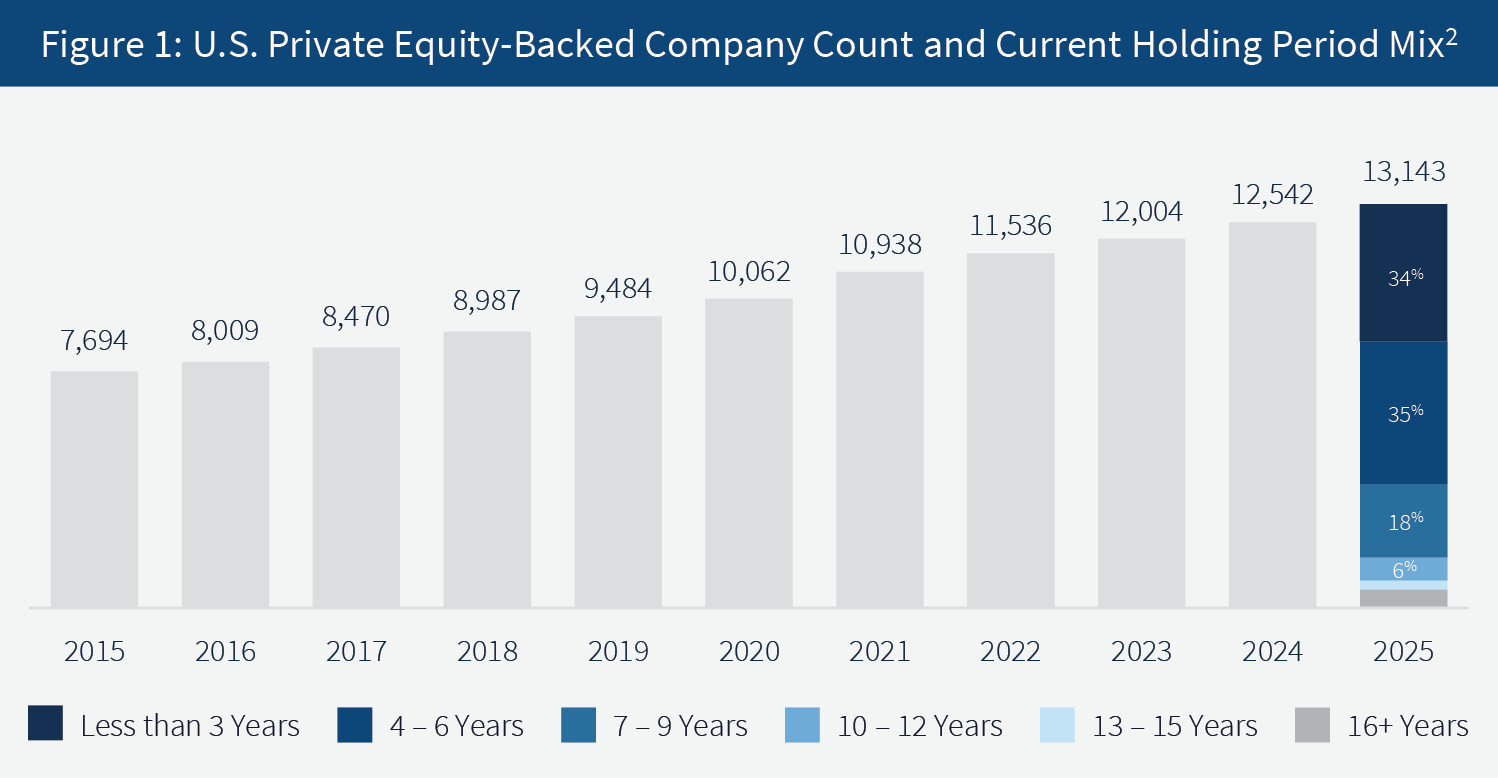
The overall backlog of private equity-owned portfolio companies has reached historic highs. More than 8,500 companies in U.S. private equity portfolios have been held for more than four years, equivalent to 66% of total U.S. buyout-backed inventory as of 2025. The typical sponsor-backed portfolio company is now held for more than six and a half years.2
Beyond the growth in awareness and transaction volumes, a dominant theme in the Secondaries market has been the increasing scale of Secondaries funds, which has driven greater activity toward the larger end of the market. Across some of the largest Secondaries platforms, the most recent fund closed at an average fund size more than twice that of the prior fund raised five years earlier.3 As a result, a significant portion of Secondaries dry powder is now concentrated among the large- and mega-cap funds, as illustrated in Figure 2.
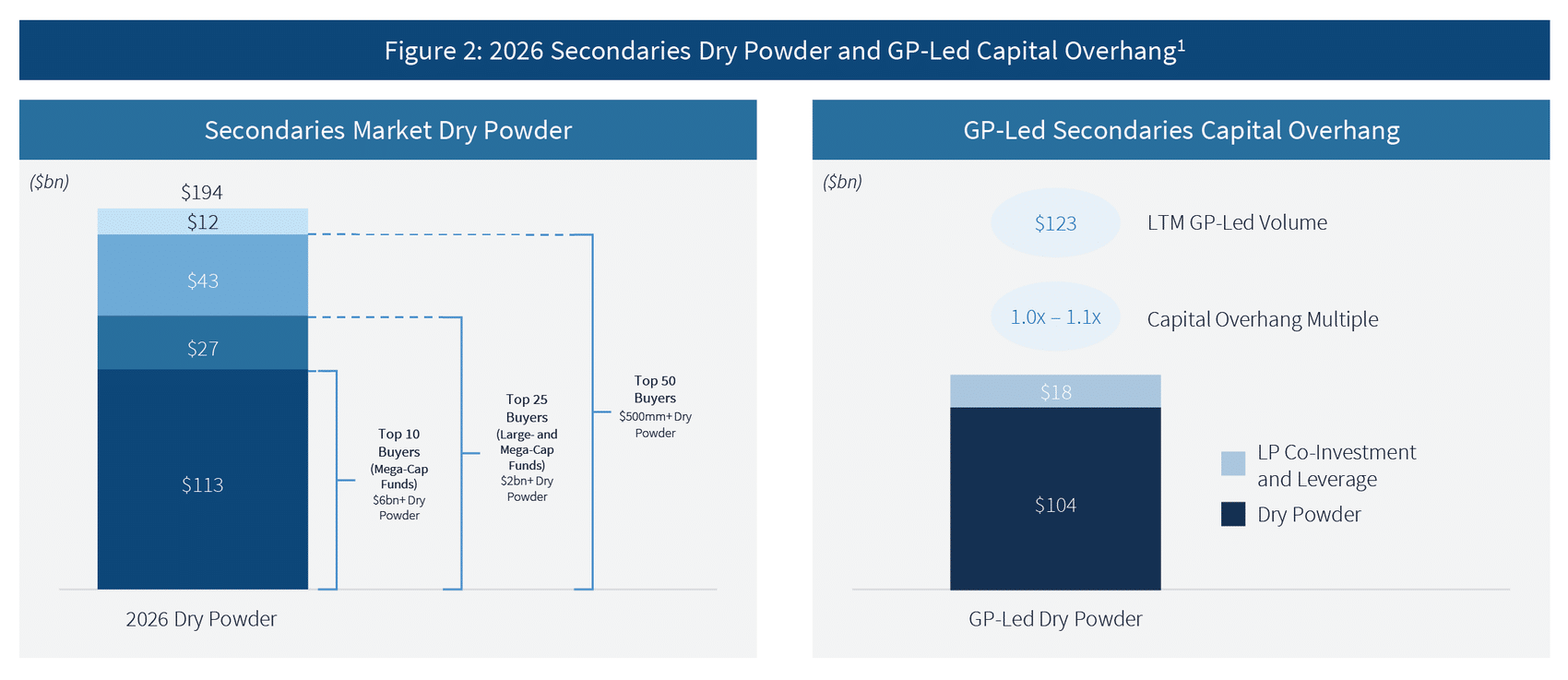
As a result, we believe the composition of capital in Secondaries funds today is built to serve upper middle market and large-cap private equity funds. According to Evercore, 58% of Secondaries dry powder is held within the top ten funds, and those funds each have at least $6 billion of stated dry powder.1 This theme has also been experienced in H.I.G.’s own deal-level data repository; in 2025, single-asset continuation vehicles (“SACVs”) with greater than $1 billion in total transaction size represented approximately $43 billion of total volume or 70% of total SACV volume. By comparison, in 2023, greater than $1 billion transactions represented less than $10 billion of total volume or approximately 40% of SACV volume.4
This scaling dynamic is powerful for the large-cap market, as exhibited by the sharp increase in the number of greater than $1 billion GP-Led transactions completed in 2025. However, we believe this dynamic has created a structural gap in middle market capital formation, one that H.I.G. Secondaries’ purpose-built platform is positioned to address with dedicated capital and tailored solutions.
2) A Coming Wave of Deals
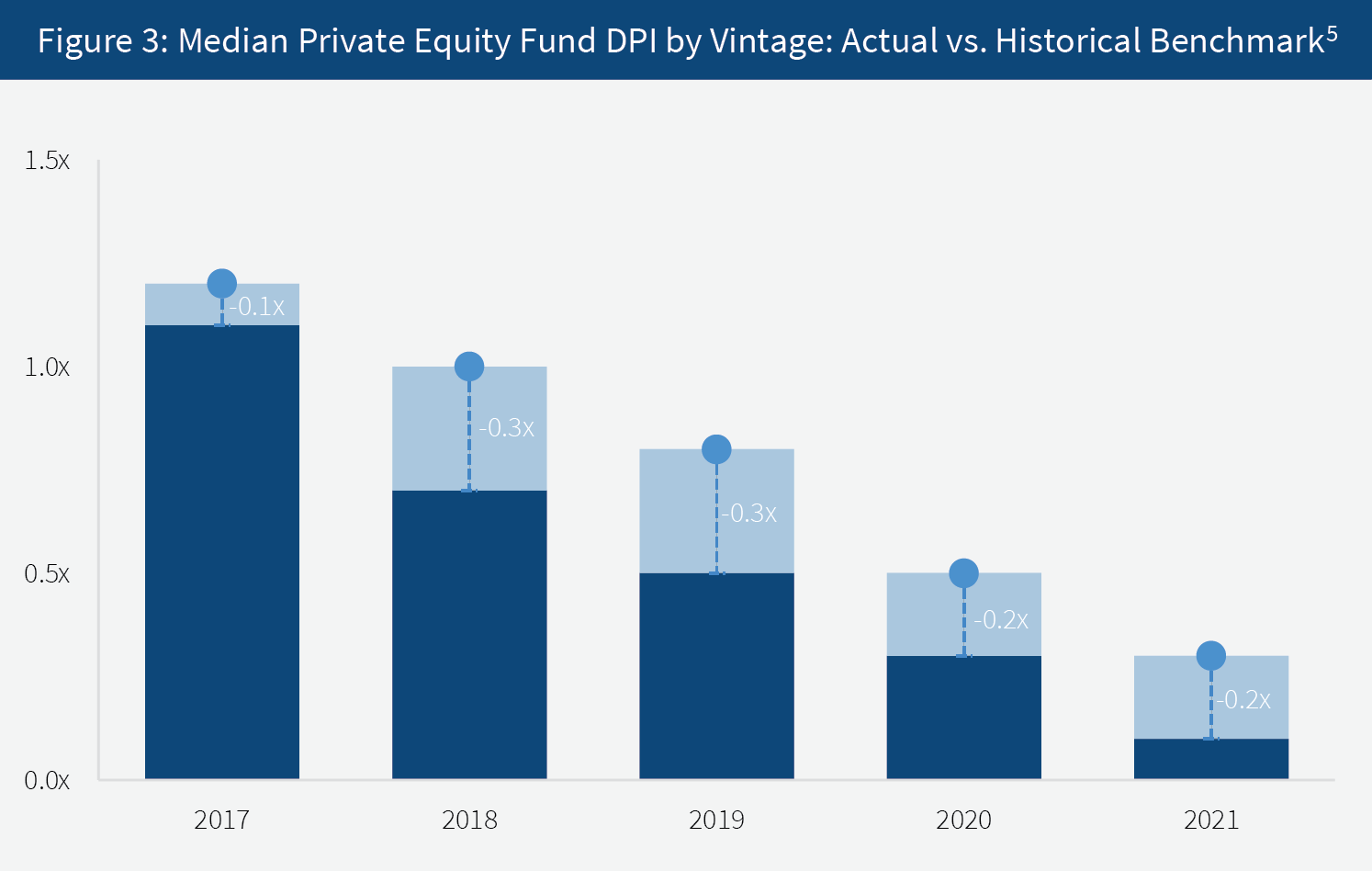
Exuberant dealmaking in the early 2020s along with a more challenging macroeconomic backdrop has ultimately led to a period of elongated duration for those investments and fund vintages. Unsurprisingly, these factors have led fund vintages from 2017 to 2021 to each generate distributions that are lagging their historical benchmark.
We believe continuation vehicle solutions are a tool to solve distribution challenges experienced in private equity portfolios, and present a range of solutions for differing stakeholders:
- For Sponsors, continuation vehicles can help to manage portfolio duration, fund liquidity needs, asset capital structures, and capital availability for buy-and-build programs;
- For Limited Partners, continuation vehicles provide optional liquidity that allows LPs with differing liquidity objectives to make portfolio decisions; and
- For Portfolio Companies, continuation vehicles have the potential to further alignment with management teams and employees, while also providing refreshed growth capital, presenting a highly valuable solution for growth plans and capital structures.
Within the middle market specifically, there are approximately 6,000 private equity-backed middle market companies waiting to be sold.6 Market data suggests more than 30% of private equity held portfolio companies have been held for five years or more.6 That would indicate that at least 1,800 middle market portfolio companies have passed the five-year hold threshold and are likely in need of liquidity solutions.6
Despite this growing investable universe, continuation vehicle penetration within the middle market segment lags dramatically behind the large-cap market. In 2025, 31% of middle market sponsors completed or marketed a GP-Led Secondaries transaction, versus 67% of large-cap sponsors.7 We believe this differential signals two things simultaneously: a large existing population of middle market sponsors who have yet to use the tool, and a structural catalyst in the 2021 vintage year era that is likely to accelerate first-time middle market sponsor adoption.
Our objective at H.I.G. is to encourage a broader set of middle market sponsors to access the continuation vehicle market. We believe middle market companies acquired in the 2020 to 2022 period that remain in portfolios today are prime candidates for liquidity solutions. That said, we aim to also extend these solutions across other vintages.
3) H.I.G. is Purpose-Built to Pursue Middle Market GP-Led Secondaries
A larger opportunity set naturally creates a wider dispersion of asset quality, and the central challenge shifts from sourcing to selection. In our view, the return outcomes will be determined not by participating in the wave, but by backing the right assets, at the right price, with the right sponsors, and the right alignment structures.
Two capabilities matter most in this environment: selection and flexibility. On selection, H.I.G. Secondaries draws on platform expertise built over H.I.G.’s 33-year history as a middle market investment firm. With more than 500 investment professionals and a track record of more than 425 private equity transactions, H.I.G. brings deep asset selection experience to the private equity Secondaries ecosystem.8 On flexibility, H.I.G. seeks to invest in strong-performing companies but recognizes that no two continuation vehicle transactions are alike. As one of the most experienced teams in middle market GP-Led Secondaries, and operating on a platform built for unique situations, H.I.G. has the resources, experience, and partnership orientation to tailor each transaction to the needs of the sponsor, its limited partners, and the portfolio company, spanning both secondary liquidity and mid-life growth capital solutions.
We believe the opportunity is clear: a structural capital gap within the middle market, a wave of maturing assets that has reached record levels, and a market in which asset selection will drive returns; an area in which H.I.G. has excelled for more than 30 years. H.I.G. Secondaries is built to meet that moment as a dedicated middle market buyer and looks forward to partnering with sponsors for years to come.